Jon Kyl, former Senate minority whip, dies at 84
The Arizona Republican served nearly three decades in Congress and died of a neurological disease.
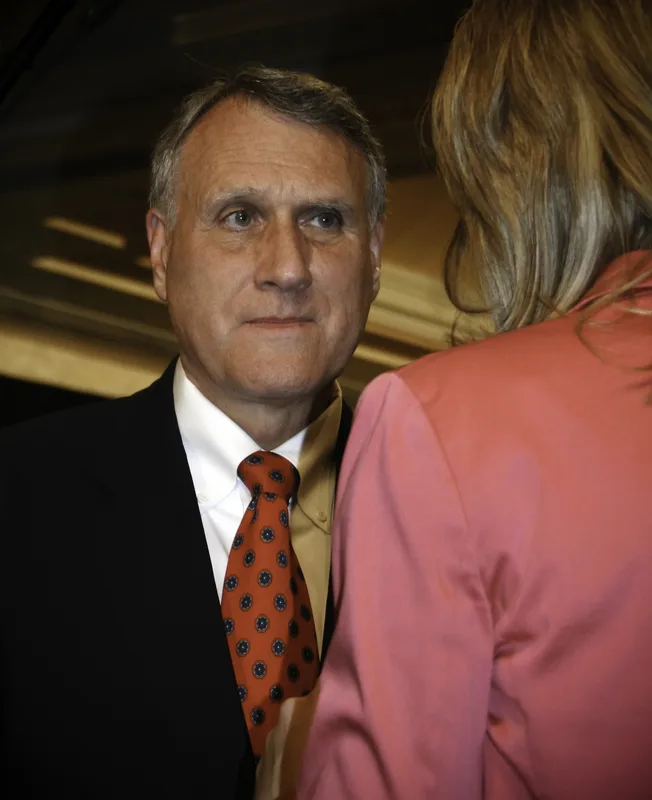
Jon Kyl, the Arizona Republican who spent nearly three decades in Congress and rose to become the Senate's second-ranking Republican, died Wednesday night at the age of 84 from complications of a neurological disease.
His family announced the death Thursday. Kyl had withdrawn from public life in December 2025, after disclosing that the disease had left him with dementia. Gordon James, a communications professional and longtime friend of the Kyl family, said Kyl died Wednesday night from a neurological disorder, according to The Associated Press.
Kyl was first elected to Congress in 1986 and served four terms in the U.S. House, representing Arizona's 4th Congressional District from 1987 to 1995. He moved to the Senate in 1995, filling the seat left open by the retirement of Sen. Dennis DeConcini, and served there until 2013. His time in Congress spanned Ronald Reagan's presidency to President Donald Trump's first term.
How he worked the Senate
Republican colleagues selected Kyl as minority whip, their second-ranking leadership post, during his last full term. He held a fractured coalition together after the 2008 elections left Republicans with 41 senators, Roll Call reported. A lawyer before he ran for office, he was at ease in the legislative detail of a bill.
His whipping relied less on personal relationships than on an ability to translate complex policy into a compelling case for a member's support. Lisa Murkowski, the Alaska Republican, described his manner in 2009.
He's got a way about him, a mannerism, I think that's not aggressive, it's not pushy. It's, come on, let's get this done.
In 1999 Kyl led the opposition that defeated the Comprehensive Nuclear Test-Ban Treaty, which the Senate rejected 48-51 in October. In 2005 Republican aides said Kyl and his staff worked behind the scenes against President George W. Bush's nomination of Harriet Miers to the Supreme Court, among conservatives who considered the White House counsel underqualified. Kyl denied it, and Miers withdrew before the Judiciary Committee voted.
The water record
Before he ran for office, Kyl helped shape Arizona's 1980 groundwater code as a lawyer representing a large water utility. The first-of-its-kind code created a regulatory framework for managing groundwater in a drought-stricken state, centered largely on population centers including Phoenix and Tucson.
In 2004 Kyl was the principal sponsor of the Arizona Water Settlements Act, which Congress approved that year. The law authorized the Gila River Indian Community water rights settlement, ending a decades-long fight and setting the community's annual water budget at 653,500 acre-feet, enough to fill more than 320,000 Olympic-sized swimming pools, and amended the Southern Arizona Water Rights Settlement Act involving the Tohono O'odham Nation.
Carl Artman, then the Interior Department's assistant secretary for Indian affairs, later called Kyl the catalyst who brought the stakeholders together and shepherded the agreement through Congress. Mitch McConnell, the Kentucky Republican who later became majority leader, called Kyl's work ethic "legendary" in a 2012 floor speech and said he had labored mostly behind the scenes for 15 years to advance the settlement.
Jeff Flake, the Republican who took over Kyl's seat after the 2012 elections, said he believed Kyl completed nine Indian water settlements, which he said gave Arizona tribes the water they needed and let the state grow sustainably.
Arizona State University's Kyl Center for Water Policy, at its Morrison Institute, carries his name, and its director, Sarah Porter, said his fingerprints are on much of what has happened in water in the state and called him one of the state's top water statesmen.
A break on immigration
Kyl backed legislation authorizing a fence stretching hundreds of miles along the U.S.-Mexico border. As a member of the Judiciary Committee in 2007, he drew criticism for joining Democrats behind a bill offering a path to legal citizenship and temporary guest-worker status for immigrants in the country without authorization. The proposal failed.
Kyl was one of his party's leading advocates of a large national security posture. He pressed for a tough line on Iran and strongly opposed plans to close the detention facility at Guantánamo Bay during the Obama administration. He served as vice chair of the Congressional Commission on the Strategic Posture of the United States, created to help prepare the country for nuclear-armed adversaries.
TIME magazine named Kyl one of the best senators in the country in 2006 and placed him on its list of the 100 most influential people in 2010.
Doug Ducey, the former Arizona governor, said Kyl's biggest impacts came from keeping the Republican caucus together in opposition to Obamacare and from his staunch support of Israel. Ducey, who called Kyl a mentor, described him in a February 2025 interview with The Associated Press as a true statesman and a workhorse among Washington's showhorses.
A lobbying practice after 2013
Kyl left Congress in 2013 and became counsel at Covington & Burling, a law and lobbying firm in Washington. His clients included Facebook, as the company investigated claims of discrimination against right-leaning users, and the conservative Judicial Crisis Network. In 2018 he guided Brett Kavanaugh, President Donald Trump's Supreme Court nominee, through the Senate confirmation process, a role known on Capitol Hill as sherpa.
The appointment to McCain's seat
Ducey appointed Kyl to the Senate in August 2018 to fill the vacancy created by the death of John McCain, his friend and former colleague. Trump praised the appointment and said he looked forward to working with "the extraordinary senator." Kyl voted to confirm Kavanaugh.
He stayed less than four months before resigning at the end of 2018, and Ducey appointed Republican Martha McSally to the seat in January 2019. Kyl then rejoined Covington & Burling. Those four months were the last of his service in Congress.
Kyl's name is also on the Kyl Institute for National Security at the University of Arizona, a nonprofit that connects university faculty and researchers with national security agencies. Robin Rand, the retired general who serves as its president and chief executive, said Kyl dedicated his adult life to the nation's security at home and abroad.
Reaction in Arizona and Washington
Senate Majority Leader John Thune, the South Dakota Republican, called Kyl a dear friend and an incredibly hard worker. "Jon Kyl loved his state of Arizona and was a true legislator's legislator," Thune said. Flake wrote on social media that Arizona had lost a giant. Julie Katsel, who worked for Kyl for 18 years and once ran his Tucson office, said she would remember his work ethic and his preparation.
Democrats joined the tributes. Gov. Katie Hobbs said Kyl was a dedicated statesman who always cared deeply for the state. Rep. Greg Stanton wrote that Kyl was a serious and principled lawmaker whose mastery of policy made him one of the most effective leaders Arizona has sent to Washington, and Sen. Mark Kelly said his work securing tribal water settlements defined the state.
Kyl was born in Oakland, Nebraska, on April 25, 1942, and grew up in a rural farming district in Iowa that his father represented in the U.S. House. His father, John H. Kyl, was president of the local Chamber of Commerce before serving more than a decade in Congress.
He came to Arizona at 18 to attend the University of Arizona, where he met his wife, Caryll, who worked as a nurse while he earned a law degree in 1966, and then practiced law in Phoenix. Like his father, he was president of the Phoenix Chamber of Commerce when he won the 1986 Republican primary over John Conlon. He is survived by Caryll and their two children, Kristine and John.
Sources for this article
8 sources · Retrieved 18 Sept 2026
- 1Associated Press report on Jon Kyl's death, published by AZFamily
- 2Roll Call, Former Arizona Republican Sen. Jon Kyl dies at 84
- 3Kyl family statement on his death, published by Fox 10 Phoenix
- 4Posted tributes from Arizona officials to Jon Kyl
- 5Arizona Capitol Times, Former Arizona Sen. Jon Kyl dies at 84
- 6KTAR News, Jon Kyl, an Arizona political giant, dies at 84
- 7KVOA, Longtime staffer talks legacy of late Arizona Sen. Jon Kyl
- 8KOLD, From Arizona to Capitol Hill, Jon Kyl's legacy after his death at 84
More from Threadline News
 PoliticsTrump's favorite CNN analyst reports a 61-point economic reversal8 Sep 2026
 PoliticsArmed man arrested after rushing Ohio candidate Amy Acton at fair8 Sep 2026
 PoliticsTSA lets non-fliers back past security at 13 airports6 Sep 2026
 PoliticsGibney documentary alleges Musk showed unusual certainty about 2024 vote4 Sep 2026
 PoliticsWoman who killed man over Walmart parking space won't be charged4 Sep 2026
 PoliticsTwo missing Juneau teenagers found dead of gunshot wounds3 Sep 2026
The Numbers
AllOfficial series, each dated to the observation it comes from.
Federal Reserve Bank of St. Louis