Education Department moves to revoke ABA authority over 200 law schools
Staff found the ABA's accreditor too close to its parent group, opening a federal review.
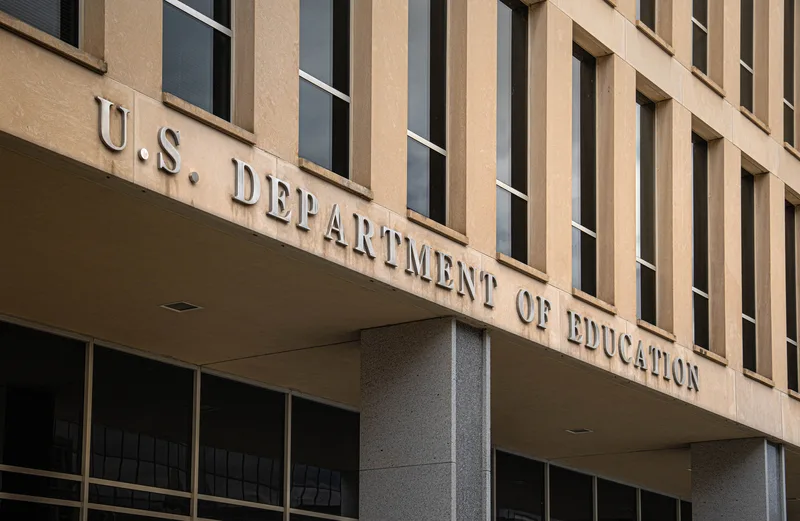
The U.S. Department of Education moved on Friday, Aug. 21, to strip the American Bar Association of its authority to accredit the nation's roughly 200 law schools, a role the organization has held since 1952.
The recommendation came from department staff in a report made public the same day, and it opens a multi-step federal process that could end the ABA's status as the gatekeeper for legal education in the United States. The Wall Street Journal, which obtained the 500-page memorandum, reported it first.
Staff concluded that the ABA's Council of the Section of Legal Education and Admissions to the Bar is not "separate and independent" from the larger association, as federal rules require, and found the accreditor out of compliance with more than 25 regulatory requirements.
What the staff found
The report also faulted the ABA for being too slow to revise its rule requiring law schools to meet diversity standards. Many of the compliance findings related to the accreditor not providing enough information about how its policies and processes meet federal standards.
The council has long maintained that its operations, office space, budget, membership and policies are separate from the ABA's professional membership arm. It is a formally distinct entity that has served as the national programmatic accreditor for law schools for more than seven decades.
The department released the report about a month before the council's accreditation powers were due for a routine renewal review.
The ABA's own count is 198 accredited law schools. Of those, 13 are free-standing institutions not tied to a university, according to the Chronicle of Higher Education, and they would have to find a new federally recognized accreditor to keep their students eligible for federal aid. The rest could rely on the accreditation of their parent universities.
A department spokesperson said staff found the accreditor "out of compliance with the agency's accreditation regulations and recognition standards," but declined to comment further, saying the process is ongoing and involves multiple stages of review, including by an independent, bipartisan advisory committee.
How the process works
The recommendation is the first step in a process that runs through several stages. The National Advisory Committee on Institutional Quality and Integrity, an 18-member panel, will review the staff report in September and make its own recommendation to Under Secretary of Education Nicholas Kent. The ABA can appeal his decision to Education Secretary Linda McMahon.
Under the Higher Education Act, the secretary can terminate an accreditor's federal recognition only after giving notice and an opportunity for a hearing. Accreditors are generally allowed up to 12 months to return to compliance before recognition is revoked.
A final decision remains months, and possibly years, away, given the due-process steps built into the law, according to the Chronicle of Higher Education. Melissa Hart, who chairs the accreditation council, said the council is confident it can address the department's concerns at next month's meeting with the advisory committee.
Hart said the council would "address any misconceptions and clarify the record" when it meets the federal advisory committee next month.
The cartel argument
Free. One click to unsubscribe.
David R. Barker, the assistant secretary for postsecondary education, described the rationale in blunt terms, saying accreditation operates without competition and reflects accreditors' own preferences.
The administration has argued that the council's ties to the ABA leave it unable to focus solely on the quality of legal education. Conservatives have also objected to what they describe as the ABA's monopoly over law school oversight since 1952.
We have said many times that accreditation, in general, operates like a cartel. When there's no competition, accreditors feel free to inject their own political preferences, their own ideologies into the work that they do
Republican lawmakers and the White House have accused the ABA of using its position to push diversity, equity and inclusion policies on law students. Harrison Fields, the White House principal deputy press secretary, said in March 2025 that Trump "represents the people, not a board of snooty, leftist lawyers."
A long-running feud
The clash extends beyond the diversity standards. The president and Republican lawmakers have criticized the ABA for rating Trump judicial appointees less favorably than judges nominated by Democrats, adding another dimension to the dispute over legal education.
The ABA is also under financial strain, with Bloomberg Law reporting earlier in August that the organization was looking to trim spending and restructure as revenue declines.
Concessions that did not land
On the same day the department released its report, the ABA's legal education council approved revisions to Standard 205, its non-discrimination rule, which still go to the House of Delegates in February. A separate rule, Standard 206, has been suspended since February 2025, shortly after Trump returned to the White House.
The council plans to vote September 8 on another diversity rule, Standard 206, which is expected to be repealed. The council had already voted in May to repeal Standard 206, but the ABA's House of Delegates initially declined to concur.
Minutes later, at the same August 4 sitting, the House adopted a resolution letting the council decide the rule's fate on its own.
What schools stand to lose
Losing federal recognition would disrupt student loan access for some law schools and could complicate students' ability to sit for the bar exam and become licensed in different states, according to Reuters. As an accreditor, the ABA determines whether stand-alone law schools can accept federal student aid.
For university-affiliated schools, the practical effect would be smaller. Those institutions would likely turn to their universities' regional accreditors to preserve access to federal aid programs, leaving the 13 free-standing schools most exposed to the change.
Those August 4 votes were the ABA's attempt to show that the council can set law school standards without the wider association's sign-off.
The department's move came despite those efforts, a sequence that suggests the administration's objections reach past the specific diversity standards and into the structure of the ABA's authority over legal education.
The advisory committee's September review is the next scheduled step, and the department said it could not comment further while the process continues.
More from Threadline News
 PoliticsMilwaukee prosecutors charge Robbiel Stokes, 15, in classmate's killing29 Sep 2026
 PoliticsMacon sheriff to seek charges against adults in park shooting28 Sep 2026
 PoliticsButler rally survivor Jim Copenhaver dies at 76, lawsuit pending24 Sep 2026
 PoliticsThree Republican senators fault Don Jr. over Russian oligarch's payments20 Sep 2026
 PoliticsTrump says Arlington arch will store drones and sniper ammunition20 Sep 2026
 PoliticsJon Kyl, former Senate minority whip, dies at 8418 Sep 2026
Free. One click to unsubscribe, in every email. We do not sell or share addresses: privacy.
The Numbers
AllOfficial series, each dated to the observation it comes from.
Federal Reserve Bank of St. Louis