Anti-Muslim posts targeting El-Sayed rose twentyfold after primary win
Attacks shifted from his socialism to his Muslim faith after the August primary.
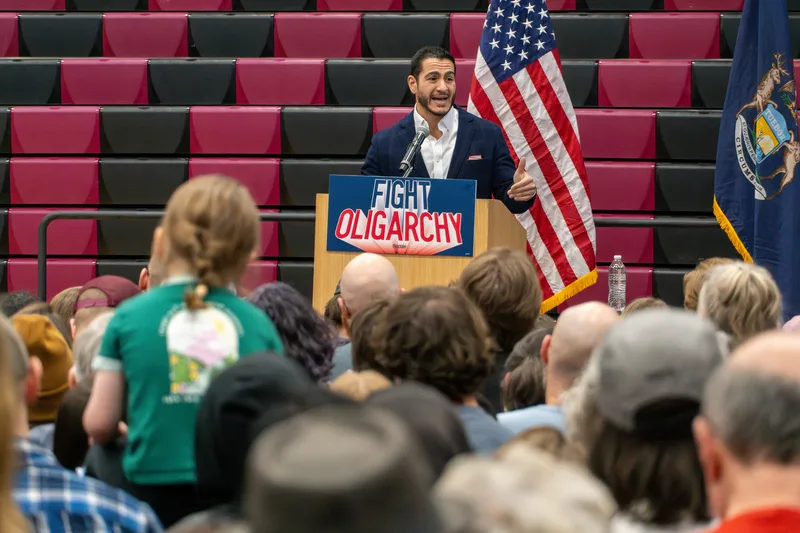
Conservative online commentary about Abdul El-Sayed shifted from his progressive politics to his Muslim faith in the weeks after he won Michigan's Democratic Senate nomination, according to a Washington Post analysis published on August 23.
By August 19, 15 days after the primary, religion had become the dominant topic of conservative conversation online about El-Sayed, overtaking the mentions of socialism and communism that had trailed him through the campaign. The finding rested on thousands of right- and left-wing posts and public statements the newspaper examined.
El-Sayed, an epidemiologist who directed the Detroit Health Department and later ran Wayne County's health agency, would be the first Muslim and the first Egyptian American to serve in the U.S. Senate if he wins in November. He placed second to Gretchen Whitmer in Michigan's 2018 Democratic primary for governor, and he faces former Republican Congressman Mike Rogers in the general election.
How the attacks shifted
Before the primary, conservative criticism centered on El-Sayed's policy positions, chiefly his support for Medicare for All, his call to abolish ICE and his progressive economics, which drew repeated charges of socialism and communism. He has rejected the socialist label, saying he believes in capitalism but that it has to be regulated.
Once the result was called, the frame changed. Within hours, Sen. Tommy Tuberville of Alabama called El-Sayed a 'TERRORIST' and a 'RADICAL ISLAMIST' on social media, in a post the Post described as a preview of the attacks that followed from influential and high-profile conservatives.
President Donald Trump referred to El-Sayed as a 'jihadist' from the Oval Office, according to Religion News Service. The National Republican Senatorial Committee published a digital advertisement that used the candidate's full name, Abdulrahman Mohamed El-Sayed, and labeled him a 'radical,' one of several messages built around his background rather than his platform.
The emphasis on his full name echoed the 2008 stress on Barack Hussein Obama's middle name.
From senators to super PACs
The attacks came from mainstream Republican officeholders, not only anonymous accounts. Sen. Ted Cruz of Texas called El-Sayed and New York City Mayor Zohran Mamdani 'Islamists' on Fox News, and said they wanted Sharia law, hated Jews and Christians, and hated the country.
Rep. Nancy Mace of South Carolina posted on X that every Muslim holding public office was a threat to the republic. The Senate Leadership Fund, a major Republican super PAC, said in a statement that El-Sayed's agenda to defund the police and abolish prisons would 'unleash terror and violent criminals' on Michigan families.
Every single Muslim holding public office in America is a Trojan horse, and a threat to both national security and our republic.
El-Sayed answered by casting the attacks as a distraction, saying Republicans relied on Islamophobia 'because their ideas are tired.'
A twentyfold surge online
A separate data brief from the Center for the Study of Organized Hate, a Washington research group, attached numbers to the increase. It analyzed 38,280 Islamophobic posts naming El-Sayed that were published between January 1 and August 10 across six platforms, among them X, Facebook, Instagram, YouTube, Reddit and Bluesky.
Posts naming El-Sayed averaged 44 a day from January through May, the group reported. That figure rose to 155 a day between June 1 and August 3, the pre-primary baseline. In the week after the primary, from August 4 to 10, the daily average reached 3,099, an increase of about 1,900 percent, or roughly 20 times the earlier rate.
The volume peaked at 6,923 posts on August 5, the day Haley Stevens conceded and the result was widely reported.
The 21,690 posts recorded between August 4 and 10 accounted for 56.7 percent of all such posts since January 1, meaning a single week produced more anti-Muslim abuse aimed at El-Sayed than the previous seven months combined. The same group reported in April that 89 elected officials had run a coordinated anti-Muslim campaign over 13 months, publishing 1,111 posts and forming a Sharia-Free America Caucus.
Free. One click to unsubscribe.
Borrowing from Europe's far right
Analysts told Religion News Service that this surge differed from earlier ones. Where past spikes mainly tied Islam to violence, the 2026 version also drew on xenophobic talking points from far-right European movements that cast Islam as an existential threat to Western civilization, a framing the service traced from a 'terror threat' to a 'civilizational threat.'
Some of the posts advocated 'remigration,' the mass removal of Muslims from Western countries, described as the only answer to what they called an Islamic takeover, invasion and conquest. Others repeated claims of an alliance between Islamists and communists.
Some Republican officials have hosted European anti-Islam figures. Reps. Chip Roy and Keith Self of Texas hosted the British activist Tommy Robinson at an April event titled 'Confronting the Islamization of Texas and our Nation.' The Dutch politician Geert Wilders headlined a conservative conference alongside the former White House official Steve Bannon in January.
El-Sayed pushes back
The shift has continued at the highest levels of the party. At an Ohio steel plant on August 21, Vice President JD Vance mispronounced El-Sayed's name and said the candidate had argued that criticisms of Sharia law were rooted in white supremacy, HuffPost reported. El-Sayed called the line an attempt to change the channel from economic issues, and on MS NOW he called Vance 'boring.'
That claim distorted a 2022 speech. El-Sayed had discussed a 2010 Oklahoma ballot measure barring state courts from considering Sharia law, arguing that the forces behind the ban were motivated by white supremacy, not opposition to any general legal argument. A federal judge struck down the Oklahoma measure in 2013 as unconstitutional.
| Jan to May | 44 |
| Jun 1 to Aug 3 | 155 |
| Aug 4 to Aug 10 | 3,099 |
| Aug 5 (peak) | 6,923 |
As filed
On X specifically, the group reported, anti-Muslim posts of all kinds, not only those naming El-Sayed, reached 11,883 on August 5, the highest daily figure it had recorded since it began counting on June 1.
El-Sayed vowed not to accept PAC donations, and the pro-Israel group AIPAC spent more than $30 million through its United Democracy Project supporting his primary opponent, Haley Stevens, a record for the group in a single race. His father-in-law, Tayeb Jukaku, a member of the founders committee of the Islamic Society of North America, contributed $300,000 to a political action committee backing his campaign. His endorsers include Senator Bernie Sanders and Representative Alexandria Ocasio-Cortez.
El-Sayed has also drawn criticism from some Jewish voters and Israel supporters over his positions on Israel and his decision to campaign with Hasan Piker, an activist accused of antisemitism. He has repeatedly declined to say whether he would appear with Piker again. Michigan Attorney General Dana Nessel, a Democrat who is Jewish, planned to skip the state party's August 29 convention, citing safety concerns.
What comes in November
El-Sayed leads Rogers 48 percent to 47 among likely voters, according to an AARP poll released this month, a margin well inside the survey's error range. Republicans had earlier tried to make Texas state Representative James Talarico, their Senate opponent there, a national target, but those attacks did not stick and Talarico kept his polling lead, and the party has since turned its focus to El-Sayed as a face for the Democrats nationally.
Muslim American leaders have described the rhetoric as political scaremongering that recurs each election cycle. Edward Ahmed Mitchell, national deputy director of the Council on American-Islamic Relations, said American Muslims had made real gains in recent years but now faced a concerted backlash. The opposition has also surfaced locally, including at a McKinney, Texas, city council meeting on the day of the Michigan primary.
Nazita Lajevardi, an associate professor of political science at the University of Michigan, warned that the rhetoric is 'incredibly dangerous' for ordinary Muslims well beyond the candidate himself.
More from Threadline News
 PoliticsJudge sets $10,000 bond for Nathalie Belizaire in neglect case2 Oct 2026
 PoliticsProsecutors seek $100,000 bond for Sinema's ex-bodyguard2 Oct 2026
 PoliticsTennessee halts executions after Christa Pike survives two doses1 Oct 2026
 PoliticsMilwaukee prosecutors charge Robbiel Stokes, 15, in classmate's killing29 Sep 2026
 PoliticsMacon sheriff to seek charges against adults in park shooting28 Sep 2026
 PoliticsButler rally survivor Jim Copenhaver dies at 76, lawsuit pending24 Sep 2026
Free. One click to unsubscribe, in every email. We do not sell or share addresses: privacy.
The Numbers
AllOfficial series, each dated to the observation it comes from.
Federal Reserve Bank of St. Louis