Chinese robot beats Usain Bolt's 100-meter record at Beijing games
Unitree ended its Shanghai debut worth about $50 billion, though its machines set none of the records.
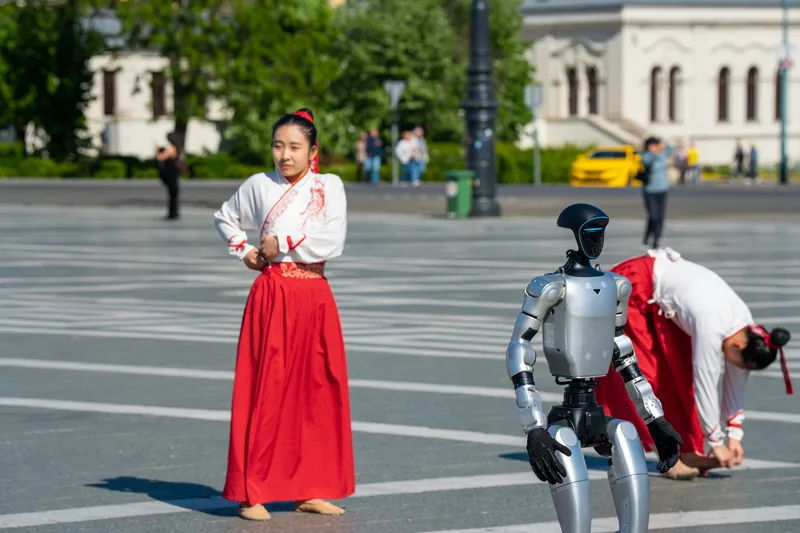
A humanoid robot ran 100 meters in 9.39 seconds on August 22, undercutting Usain Bolt's 9.58-second human record and marking the sharpest sign yet of how fast China's robotics sector is moving.
The machine, Tiangong Ultra, was developed by the Beijing Humanoid Robot Innovation Center, also known as X-Humanoid, and it won its heat at the opening of the five-day World Humanoid Robot Games, now in its second edition. The Olympics-style event is being held in the National Speed Skating Oval built for the 2022 Winter Olympics, organizers said.
Honor's robot Lightning, built by the Chinese smartphone maker, finished second at 9.47 seconds, also inside Bolt's mark. Tiangong Ultra fell behind early and overtook Lightning near the line, Reuters reported. Before the official opening, Honor said Lightning had run 9.32 seconds in a trial, reaching a peak of 14.5 meters per second.
What the result signals
The games function as an industrial audition more than a sporting event. In November 2023 China's industry ministry issued a guideline on humanoid robots, setting targets for an innovation system by 2025 and mass deployment by 2027, with policymakers and companies wagering that gains in artificial intelligence and hardware would move the machines into factories and warehouses. President Xi Jinping has singled out the sector for support, and state media now celebrate the competitions as a national showcase.
The intensity is higher than last year, which places significant demands on the robot's battery management and thermal dissipation capabilities.
That strain showed on the track. Both sprinters ran straight into a thick mat placed to stop them, and Tiangong Ultra stumbled into the sidelines while Lightning collapsed after the race and was carried off on a stretcher, Reuters reported. Braking remains an unresolved engineering problem, one that separates a fast robot from a usable one.
A year earlier, the same robot had won the 100 meters in 21.50 seconds.
The money behind it
Investor appetite was visible days before the games opened. Shares in Unitree, China's best-known humanoid robot maker, closed more than fivefold above their offer price on their Shanghai debut on August 19, giving the company a market value of about $50 billion at the close. Neither of the record-setting machines was Unitree's, though one of its H1 robots ran unaccompanied down the finishing straight at Beijing's second robot half-marathon this year, Reuters reported.
Unitree's rise has drawn scrutiny abroad. The Pentagon added the company in June to its list of Chinese military companies, The Associated Press reported, and Beijing has rejected the accusation.
The United States has tightened its stance more broadly. In July the Federal Communications Commission added advanced robotic devices, including humanoids and quadrupeds, to its covered list, barring new equipment authorizations for foreign-made models on national security grounds, The Associated Press reported. Models already authorized are not affected. China makes most of the world's humanoid robots.
The event itself has grown into a barometer for the sector. Organizers entered 2,056 robots from 666 teams across 16 countries and six continents, up from 280 teams at the inaugural edition. A Forbes contributor's analysis put the robot count up 311 percent from last year and counted 1,301 individual matches scheduled over five days. About 96 percent of the entries were Chinese.
The Forbes writer described the schedule as a map of where the industry expects to sell. The games split into about 50 events, roughly 30 competitive sports and 20 work-scenario contests, the latter rewarding robots that finish factory and office tasks on their own. The calendar also includes table tennis, soccer, dancing and industrial-task contests, and while basic running now demands full autonomy, harder feats still allow human teleoperation.
Free. One click to unsubscribe.
This year's program also added a test for robotic hands, judging speed and accuracy at precision tasks such as tightening screws, opening bottles and picking up beads with tweezers, Reuters reported. The move toward work tasks reflects the sector's biggest problem, showing that prototypes can perform outside a controlled hall.
Beyond the sprint
The sprint was not the only mark to fall. In a standing high jump, an X-Humanoid machine reached 2.88 meters, organizers said, far above the 0.95 meters that was the best humanoid result at last year's games. The same maker built the record-breaking sprinter.
Other events produced similar gaps. A robot of the same model as the 100-meter champion ran 400 meters in 39.7 seconds, inside Wayde van Niekerk's human record of 43.03 seconds, Reuters reported. Honor's Lightning had earlier won a humanoid half-marathon in 50 minutes and 26 seconds, almost seven minutes faster than Jacob Kiplimo's men's world record of 57:20, set in Lisbon in March.
Experts caution that humanoid robots remain mostly demonstration pieces, with wide gaps between staged performance and real deployment.
The reliability gap was on display around the track. Many robots crashed out in various ways during the games, including at least one that caught fire, The Associated Press reported. The problem is not new: at the world's first robot half-marathon in Beijing in April 2025, engineers jogged alongside their machines, some collapsed at the starting line, and only a fraction finished, Reuters reported.
Analysts and executives have tied the sharp gains to a growing supply chain, one bolstered by subsidies and by the falling cost of components, Reuters reported. The visible hand of the state, it said, drove some of the improvement, turning a field of academic curiosities into a competitive commercial market.
China's bet on robots
China is pouring effort into humanoid robots as a strategic industry, and the Beijing games have become the clearest public measure of its progress. Once a curiosity organized by academic teams and hobbyists, the competitions are now a state-celebrated proving ground for commercial machines trying to show they work beyond the spectacle, Reuters reported. Over the past decade the contests have grown from a science fair into a strategic showcase.
The games opened the same week as the 2026 World Robot Conference in Beijing, where companies showed around 3,000 products, including humanoid robots. Hundreds of the machines marched in formation onto the field during the opening ceremony, a display of coordination meant to signal the scale of the effort. More than 2,000 robots are competing across the five days.
For all the polish, the finish was messy. Tiangong Ultra careered into the padded barrier as onlookers stepped back, Reuters reported. The robots lacked Bolt's flair, it said.
Lightning stood 169 centimeters tall with 95-centimeter legs during the earlier half-marathon, and its researchers lengthened its legs by 10 centimeters before the games, according to the state broadcaster CCTV.
The wider technology race
The performances land inside a hardening technology contest between Beijing and Washington. The FCC restriction and the Pentagon's designation of Unitree came seven weeks apart, and China still makes most of the world's humanoid robots, The Associated Press reported. Beijing has rejected the security concerns behind the U.S. measures.
For investors, the week produced a robot beating a human record on television and a robot maker valued at about $50 billion on its first day of trading. Whether either converts into products at scale is the question the work events were built to answer, and Forbes cast the schedule as a gauge of where the whole industry is heading.
The human record still belongs to Bolt, whose 9.58 seconds in Berlin has stood since 2009.
More from Threadline News
 BusinessSpent SpaceX rocket carves 60-foot crater on the Moon19 Aug 2026
 BusinessTreasury yields hit a 19-year high as debt supply meets thinner demand19 Aug 2026
 BusinessTrump pauses 50% tariffs on $20 billion in Canadian goods19 Aug 2026
 BusinessMortgage rates near 7% as 30-year Treasury yield tops 5.32%18 Aug 2026
 BusinessFrasers rescues Harvey Nichols in pre-pack deal, saving 1,000 jobs17 Aug 2026
 BusinessCourt filings tie Anthropic's book purchases to AI training16 Aug 2026
Free. One click to unsubscribe, in every email. We do not sell or share addresses: privacy.
The Numbers
AllOfficial series, each dated to the observation it comes from.
Federal Reserve Bank of St. Louis