Spent SpaceX rocket carves 60-foot crater on the Moon
The Falcon 9 upper stage hit near the western limb on August 5, and came in shallower than NASA had forecast.
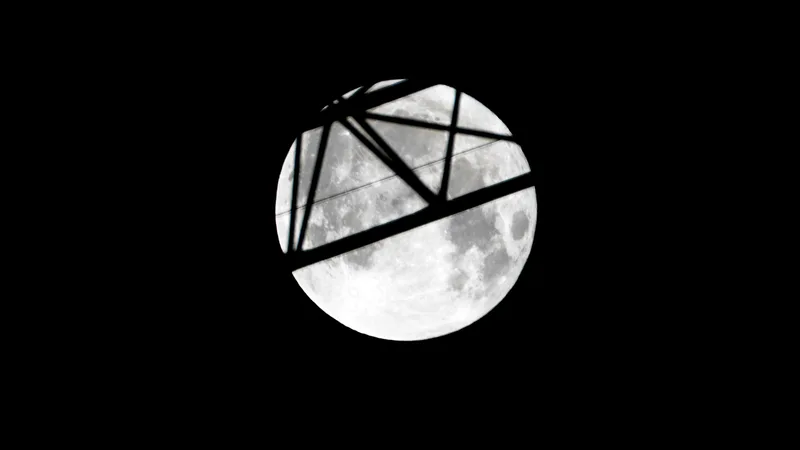
NASA has measured a fresh crater 60 feet wide on the Moon, carved when the discarded upper stage of a SpaceX Falcon 9 struck the surface on August 5, the clearest accounting yet of the debris left behind by a commercial lunar flight.
The agency said its Lunar Reconnaissance Orbiter photographed the site between August 11 and 12, six days after the impact, and that the pit is less than 10 feet deep.
The rocket body had drifted through space for more than 18 months before orbital dynamics bent its path into the Moon. SpaceX released it in January 2025, after it delivered two commercial landers out of Earth orbit.
What the orbiter saw
NASA said controllers tilted the spacecraft so its cameras pointed down as it passed about 60 miles above the surface at roughly a mile a second. The orbiter runs a near-polar circuit of the Moon every two hours, and it took six days for that path to carry it over the impact.
Dark and bright streaks radiate from the crater. NASA said the dark material was thrown up from about a foot and a half down and is rougher than its surroundings, weathered over ages by solar wind, galactic cosmic rays and micrometeorite impacts. The brighter streaks near the rim are fresher rock and soil from deeper below.
The January 15, 2025 launch, from Launch Complex 39A at Kennedy Space Center, carried Firefly Aerospace's Blue Ghost Mission 1 and the Japanese company ispace's Resilience lander, flown as HAKUTO-R Mission 2. Both went up under NASA's push to hand lunar deliveries to private companies. Blue Ghost touched down near Mons Latreille in Mare Crisium on March 2, 2025, and finished its run on March 16. Resilience crashed on descent on June 6, 2025, which ispace traced to a fault in its laser rangefinder.
A rocket set adrift
After releasing the landers, the stage was left in space with no plan to bring it back down, the standard fate of hardware sent beyond Earth orbit.
Unlike stages dropped in low orbit, which burn up over the ocean, deep-space boosters drift in long, unstable paths shaped by the pull of the Sun and Earth and by the pressure of sunlight itself. Over 18 months those forces bent the Falcon 9 stage onto a course that crossed the Moon.
Benjamin Fernando, a planetary scientist at Los Alamos National Laboratory who led a study of the impact, said it "could give us valuable information on localized seismic impacts, dust and plume dynamics and hazards associated with artificial space debris impacts."
A preprint posted in July 2026 modelled how debris from a break-up in Earth-Moon distant retrograde orbits would spread. Its authors found fragment impact rates below 3.5 percent and described the hazard as high-velocity fly-bys rather than a persistent co-orbital threat. The paper has not been peer reviewed.
Commercial lunar traffic is expected to climb through the late 2020s, sharpening the question of who answers for spent hardware once a mission ends.
Measuring by shadow
The orbiter's Narrow-Angle Camera can pick out features as small as three feet across, sharp enough to trace the rim and floor of the new crater. Scientists read the width where the rim stood out against the light, and took the depth from the length of the shadow across the floor.
NASA had forecast a crater about 60 feet wide and 12 feet deep. The width came in as predicted. The depth did not: the pit is less than 10 feet, shallower than any of the pre-impact estimates.
Before the images arrived, NASA's Center for Near Earth Object Studies had drawn two oval zones where the stage was likely to come down, each about 2.1 miles long and 0.4 miles wide. One allowed for the Moon's uneven terrain; the other assumed a smooth sphere.
The crash itself was watched from Earth. Fernando and a colleague recorded it with the ERIS instrument on the Very Large Telescope in Chile, and a Boston University astronomer picked up the plume spectroscopically. What no instrument could do was photograph the crater until the orbiter came around.
NASA passed its predicted impact point to the Republic of Korea, whose Danuri orbiter photographed the site a few hours later with its high-resolution LUTI camera and found the prediction accurate to about 0.6 miles. The Danuri team then sent coordinates back to help aim the Lunar Reconnaissance Orbiter.
Second of its kind
It is the second confirmed case of a derelict rocket stage drifting into the Moon uncontrolled. The first was an upper stage from China's Chang'e 5-T1 mission, launched in 2014, which struck the far side near Hertzsprung crater on March 4, 2022 and left an unusual double crater. That object was first identified as a SpaceX upper stage before astronomers corrected the attribution. Failed landings, of which there have been several, are a separate category.
Deliberate impacts have their own history. NASA's LCROSS mission drove a Centaur rocket stage into Cabeus crater in October 2009, kicking up a plume so scientists could search it for water ice. They found it. The Falcon 9 stage arrived with no such plan.
Traffic in cislunar space
The crater is small against a Moon already pocked by natural strikes, most of them meteoroids, which pepper the surface constantly. What sets this one apart is its source, a piece of a commercial rocket, at a moment when private companies are sending more hardware toward the Moon than at any time before.
The count of human-made impacts is still small. But each added mission leaves more spent hardware on paths that are hard to predict.
What the impact risked
NASA said the stage posed no danger to Earth. It came closer to hardware at the Moon: Fernando and his co-authors calculated that the upper stage passed within kilometres of the Danuri orbiter about two minutes before it hit.
The stage weighed about 4,000 kilograms, or four metric tons, though the researchers note the exact figure is not known because it depends on how much propellant was left. It hit at about 5,400 miles per hour, releasing energy equivalent to roughly three tons of TNT.
It came down near the craters Einstein and Bell, at 19.5 degrees north and 93.3 degrees west. That is just beyond the Moon's western limb, on ground visible from Earth only because libration had tipped it into view, and it struck at 2:35 a.m. Eastern on August 5.
NASA has not said whether it will keep watching the site or study the debris further, and it has not put a timeline on any follow-up. Nor has it detailed what, if anything, changes in how discarded upper stages are handled once a lunar delivery is done.
What is still unknown
For now the crater stands as a marker of the traffic building around the Moon. The two landers the rocket carried finished their missions in 2025, more than a year before the stage that lifted them left a mark of its own.
Sources for this article
9 sources · Retrieved 19 Aug 2026
- 1NASA, LRO Images Falcon 9 Crater on Moon, Learns New Details
- 2CBS News, NASA images show 60-foot-wide crater on moon after SpaceX rocket booster crash
- 3CNN, New images reveal what happened when a SpaceX rocket slammed into the moon
- 4NBC News, NASA spots new crater on the moon created when a SpaceX rocket crashed
- 5Republic World, NASA Orbiter Captures 60-Foot Crater Left After Rogue SpaceX Rocket Crash
- 6Wikipedia, 2026 SpaceX lunar impact
- 7eciks.org, SpaceX Falcon 9 upper stage crashes into Moon near Einstein Crater
- 8SatNews, Discarded SpaceX Falcon 9 Upper Stage Impacts Lunar Surface Following 2025 Lander Mission
- 9Firefly Aerospace Inc., Form 10-Q filed 11 Aug 2026
More from Threadline News
 BusinessMeta's 'problematic use' label undercounted teen harm, witness testifies20 Aug 2026
 BusinessTreasury yields hit a 19-year high as debt supply meets thinner demand19 Aug 2026
 BusinessTrump pauses 50% tariffs on $20 billion in Canadian goods19 Aug 2026
 BusinessMortgage rates near 7% as 30-year Treasury yield tops 5.32%18 Aug 2026
 BusinessFrasers rescues Harvey Nichols in pre-pack deal, saving 1,000 jobs17 Aug 2026
 BusinessCourt filings tie Anthropic's book purchases to AI training16 Aug 2026